Can Job Creation Help South Asia to Escape Global Economic Crisis?
| JOBS, JOBS, AND JOBSOctober 28, 2009 - In South Asia more than 150 million people are expected to enter the prime working age population over the next decade. Creating jobs for them will contribute to growth, equity, and peace in the region. Download this feature (pdf) |
South Asia's recent rapid growth must be more inclusive to address the dichotomy of the growing gap between leading and lagging regions.
GLOBAL ECONOMIC CRISIS
South Asia has recently attracted global attention for its rapid growth. “Notwithstanding this impressive progress, South Asia remains home to a large number of poor,” saidEliana A. Cardoso, Chief Economist for the South Asia Region, World Bank. “Their welfare has become more precarious in this global economic crisis. The poor countries have little economic cushion to protect vulnerable populations from this crisis, which was followed closely on the heels of a global spike in food prices.”
According to a recent World Bank report, Accelerating Growth and Job Creation in South Asia, timely and relevant in the context of the ongoing global crisis, there is a broad consensus that South Asia must continue to grow rapidly and possibly faster to eradicate poverty more comprehensively than in the past. “There is also an emerging consensus that this growth must be more inclusive to address the dichotomy of the growing gap between leading and lagging regions,” said Cardoso.
SOUTH ASIA NEEDS TO GROW ON MULTIPLE FRONTS
Rural markets and lagging regions have huge untapped potential. It has increased with expanding role of the services sector. Combined with an improved role of unorganized and organized manufacturing and services has eroded steadily the overall share of agriculture incomes in rural areas.
Rural households today depend on more than one source for their incomes. Temporary rural to urban migration has increased incomes, which otherwise depended on agriculture. Other individuals within the household have increasingly involved in home-based work. This diversification helps stabilize household purchases.
HOW TO GROW?
Sustaining high growth rates is not easy. “Growth results from complex interactions between policies, institutions, geography, and leadership. The question is can South Asia achieve both high and inclusive growth?” said Cardoso.
The factors that can contribute to high and inclusive growth are labor mobility, more jobs, increased productivity, skills and education, and resolution of internal conflict. Inclusive growth is not about balanced growth but shared opportunities. Spatial disparities in growth are inevitable when growth accelerates and countries make the transition from being an agricultural to an industrialized economy.
HOW TO CREATE JOBS?
The key asset of South Asia is its people. “South Asia has a young population and the lowest female participation rate in the labor force. The demographic dividend will result in more workers entering the labor force in the future,” said Cardoso. Hence, the region must exploit the unparalleled advantage of demographic dividend that could structurally transform South Asia economically and socially. The structural transformation – the shift of capital and labor away from low-productivity (traditional agriculture) and into high-productive sectors (modern agriculture, manufacturing, and services) – is needed to accelerate growth and create jobs. Labor supply growth is 2.3% per annum in South Asia, above the global average of 1.8%. The increased labor force can contribute to additional growth.

GROWTH AND EQUITY
Job creation is good for growth and good for equity. “South Asia’s young demographics suggest that its labor force is growing faster than its population, and millions of new entrants will not be able to finds jobs,” said Ejaz Ghani, Economic Advisor for the South Asia Region, World Bank. More than 150 million people are expected enter the prime working age population over the next decade. “Creating jobs for them will contribute to growth, equity, and peace in the region.”
MORE PRODUCTIVE JOBS
A key challenge facing the region is whether it can create enough good jobs to convert this large population into a productive asset. The region with weak infrastructure has also constrained the expansion of the manufacturing sector, thereby adversely affecting both growth and employment creation.
WHAT WILL CREATE MORE PRODUCTIVE JOBS?
First, rapid growth is essential to create more and better jobs.
Second, restrictive labor laws need to be reformed to remove barriers to creating jobs in the formal sector. Labor market reforms should be accompanied by improved social protection.
Third, for South Asia to accelerate growth and create good jobs, it will require much better training and education to produce more skilled labor.
HOW HAS SOUTH ASIA FARED IN CREATING JOBS?
“In terms of numbers, South Asia is one of the fastest job creators in the world,” saidGhani. The largest job creation in South Asia is in the services sector, but the manufacturing sector is also showing progress. South Asia now needs to generate non-agricultural jobs in lagging regions of South Asia, where 500 million people live.
“The key link between growth and inclusiveness is creation of good jobs," said Ghani. South Asia is already undergoing a major structural transformation based on rapid growth of services and manufacturing. The GDP share of agriculture is shrinking fast. As the agriculture sector modernizes, and farmers move up the value chain, and make better use of retail networks, storage facilities, and transportation facilities from the fields to the markets, more jobs are likely to migrate from agriculture to other sectors. This trend is likely to continue in the future, although the growth rates in both manufacturing and agriculture could be accelerated.
EAST ASIA OF 1970S AND 1980S
“The recent history of South Asia raises hope for the region. Growth has been rapid, and some parts of the region are beginning to resemble the economies of East Asia of the 1970s," said Ghani. Yet this growth has not had a matching impact on employment, so the incidence of poverty remains large and, despite some small downward movement in recent times, at record levels by global standards. “This also means that the associated with poverty, such as low literacy rates, malnutrition, and poor working conditions, persist.”
It is therefore important for the countries to turn their attention to spreading the benefits of growth to larger segments of the population. While the initial impulse is likely to result in government programs and subsidies, the region has to rely on private industry to create jobs.
On the other hand the restrictive labor laws have reduced employment prospects in organized manufacturing but also constrained its growth by adversely affecting investment and productivity.
sOURCE--http://www.worldbank.org.in/WBSITE/EXTERNAL/COUNTRIES/SOUTHASIAEXT/INDIAEXTN/0,,contentMDK:22366748~menuPK:295589~pagePK:2865066~piPK:2865079~theSitePK:295584,00.html
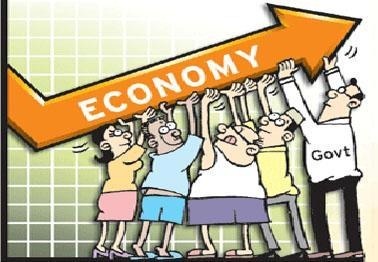 The major downside risks to growth are weather, a disproportionate spike in petroleum prices, and a slowdown in the advanced economies. Inflation and a large current account deficit are major concerns. The Survey cautions that higher growth and a faster monetisation of the economy, through financial inclusion, may mean increased money supply and hence more inflationary pressures. It has recommended a phased entry of foreign direct investment in multi-brand retail, apparently in response to the concerns of farmers and consumers. That should also add to stable capital flows. Given its upbeat tone on growth, the Finance Minister is expected to meet the fiscal targets. As part of its reform agenda, the Survey calls for a streamlining of land acquisition and environment clearance procedures, using smart cards to target subsidy payments and issuance of basic banking licences. There should be an unrelenting thrust on infrastructure development. None of these is new or visionary but the Survey has stressed the doable and underlined the priorities in a way that demonstrates pragmatism.


