Showing posts with label THE HINDU. Show all posts

Cautiously optimistic (Economic Survey --The Hindu Editorial)


The Economic Survey 2010-11 is positive on the macroeconomy without glossing over the challenges. The economy's resilience is seen in its ability to withstand two shocks in quick succession. The ripple effects of the global economic crisis (2007-09) that devastated world growth, trade, and finances have persisted in the form of the European fiscal crisis. 

On the domestic front, the farm sector that saw a negative growth in 2008-09 was further hit by erratic monsoons, severe drought, and unseasonal rains in two successive years. Despite this, the economy is poised to grow at rates seen during the pre-crisis period. On top of an estimated 8.6 per cent growth during the current year, the economy is projected to grow at 9 per cent during 2011-12. The optimistic forecasts as well as the downside risks are in line with the assessment of the Prime Minister's Economic Advisory Council. 

The services sector, for long “the power house of the economy”, with a more than 57 per cent share of the GDP in 2009-10, has started gaining momentum. That should augur well for the medium term growth prospects. Another favourable feature is that India's demographic dividend is yet to peak. The growing trend in savings and investment rates should benefit from the gradual withdrawal of stimulus measures by the government. In a message that could be a pointer to the strategy in the Budget, the Survey notes that once the economy operates around full capacity, it is not the savings and investment rates that will drive growth but skills development and innovation.

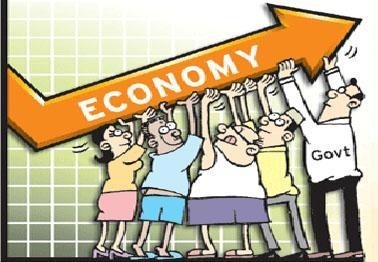
http://trak.in/wp-content/uploads/2009/10/Indian_economic_recovery1.jpgThe major downside risks to growth are weather, a disproportionate spike in petroleum prices, and a slowdown in the advanced economies. Inflation and a large current account deficit are major concerns. The Survey cautions that higher growth and a faster monetisation of the economy, through financial inclusion, may mean increased money supply and hence more inflationary pressures. It has recommended a phased entry of foreign direct investment in multi-brand retail, apparently in response to the concerns of farmers and consumers. That should also add to stable capital flows. Given its upbeat tone on growth, the Finance Minister is expected to meet the fiscal targets. As part of its reform agenda, the Survey calls for a streamlining of land acquisition and environment clearance procedures, using smart cards to target subsidy payments and issuance of basic banking licences. There should be an unrelenting thrust on infrastructure development. None of these is new or visionary but the Survey has stressed the doable and underlined the priorities in a way that demonstrates pragmatism.

Read Users' Comments (0)

The Telengana issue (Hindu Article)

United Andhra Pradesh with constitutional empowerment of Telangana ‘best way forward' 

Srikrishna Committee says separate Telangana is ‘second best option' if unavoidable & all three regions agree
— PHOTOS: P.V . SIVAKUMAR, PTI/ SHAHBAZ KHAN

HARDENING STANCE: Telangana Rashtra Samiti president K. Chandrasekhara Rao with BJP leader Bandaru Dattatreya at a dharna in Hyderabad on Thursday. Both parties are firm on the demand for a separate Telangana State. 
 
NEW DELHI: The Srikrishna Committee has favoured maintaining the status quo of a united Andhra Pradesh and described the demand for a Telangana State as the “second best option.”

In its report, which was made public on Thursday, the Committee found the option of a united Andhra Pradesh the “most workable” in the circumstances and in the best interests of the social and economic welfare of people. “In this option, it is proposed to keep the State united and provide constitutional/statutory measures to address the core socio-economic concerns about the development of the Telangana region,” it said.

The report was submitted to Union Home Minister P. Chidambaram on December 30.

The 461-page report lists six options —

(I) maintaining the status quo;
(II) bifurcation of the State into Seemandhra and Telangana, with Hyderabad as a Union Territory, and the two States developing their own capitals in due course; 
(III) bifurcation of the State into the Rayala-Telangana and coastal Andhra regions, with Hyderabad being an integral part of Rayala-Telangana; 
(IV) bifurcation of Andhra Pradesh into Seemandhra and Telangana, with an enlarged Hyderabad metropolis as a separate Union Territory; 
(V) bifurcation of the State into Telangana and Seemandhra as per the existing boundaries, with Hyderabad serving as the capital of Telangana, and Seemandhra having a new capital; and
(VI) keeping the State united by simultaneously providing certain definite constitutional/statutory measures for socio-economic development and political empowerment of the Telangana region — creation of a statutorily empowered Telangana Regional Council.


Union Home Minister P. Chidambaram addresses the media in New Delhi after meeting political parties from Andhra Pradesh on the Telangana issue. 
 
The Committee found the fifth option the “second best,” with a rider that separation “is recommended only in case it is unavoidable and if this decision can be reached amicably among all the three regions.” Considering the option of bifurcating the State into Telangana and Seemandhra as per the existing boundaries, the Committee felt that the continuing demand for a separate Telangana had some merit, and “is not entirely unjustified.” In case, this option was exercised, the apprehensions of the coastal Andhra and Rayalaseema people and others who settled in Hyderabad and other districts of Telangana about their investments, property, livelihood and employment would need to be absolutely addressed.

“Considering all aspects, the Committee felt that while the creation of a separate Telangana would satisfy a large majority of people from the region, it will also throw up several other serious problems. Therefore, after taking into account the pros and cons, the Committee did not think it to be the most preferred, but the second best option,” the report said.

Maintaining the status quo was the least-favoured option. It also found the second and third options “not practicable.” The Committee felt that the fourth option of bifurcating Andhra Pradesh into Seemandhra and Telangana, with an enlarged Hyderabad metropolis as a separate Union Territory, was likely to meet with stiff opposition from the Telangana protagonists, and it might be difficult to reach a political consensus on making this solution acceptable to all.

On the sixth option of keeping the State united, the Committee said it could be done through the establishment of a statutory and empowered Telangana Regional Council with adequate transfer of funds, functions and functionaries. “The Regional Council would provide a legislative consultative mechanism for the subjects to be dealt with by the Council.”


The Committee felt that with firm political and administrative management, it should be possible to convince the people of the importance keeping the State united, as this option would be in the best interests of all, and would provide satisfaction to the maximum number of people. “It would also take care of the uncertainty over the future of Hyderabad as a bustling educational, industrial and IT hub/destination.”

Dwelling further on the sixth option, it said that for managing water and irrigation resources equitably, a technical body — water management board — and an irrigation project development corporation with an expanded role were recommended. This should meet all the issues raised by the Telangana people satisfactorily, it said. Flagging socio-economic development and good governance as the core issue, the Committee, keeping the national perspective in mind, was of the considered view that “this option stands out as the best way forward.”

The five-member Committee, headed by the former Supreme Court judge, B. N. Srikrishna, was appointed on February 3, 2010. It examined in detail the issues pertaining to the current demand for a separate Telangana as well as the demand for a united State. The Committee examined all aspects of the situation. Keeping in view the local, regional and national perspectives, it gave the six options.

It examined such parameters as regional, economic and equity analysis, education and health, water resources, irrigation and power development, public employment. It also looked into the issues relating to Hyderabad and the sociological and cultural issues. In the past 11 months, it consulted representatives of industry, trade, trade unions and organisations of farmers, women and students, and all sections of the people, especially the political parties.
Read Users' Comments (0)

The burden of injustice

t is a shocking reflection on the flaws in our criminal justice system that less than one out of three people lodged in Indian jails is a convict. The vast majority of the prison population, as many as about 2.5 lakhs or 70 per cent, is made up of undertrials awaiting justice. As Prime Minister Manmohan Singh told the conference of Chief Ministers and Chief Justices, many of them have been in jail “for periods longer than they would have served had they been sentenced.” The Law Commission of India’s 78th report on the “Congestion of undertrial prisoners in jail,” submitted in 1979, also has a topical feel about it.

The situation today is not unlike what it was then — people languish in jail for the want of resources to seek bail, for the lack of proper legal aid, and the hopelessly sluggish pace at which the judicial system moves. Coupled with this is the presence of a police force that seems less interested in securing convictions than in making summary arrests, effectively using custody as a form of preventive detention.

If the problem of undertrials has proved so intractable, it is because it is a manifestation of fundamental and deep-rooted flaws in the criminal justice system.

The immediate task is to identify those who are eligible for bail and ensure their release. Under the Code of Criminal Procedure (Amendment) Act 2005, those accused of offences for which the death penalty is not prescribed are entitled to be released if they have been in detention for more than half the stipulated period of imprisonment. Also, the majority of the undertrial population is behind bars for petty offences and, by the Centre’s admission, “is under lock up in the absence of trial.”

Chief judicial magistrates have been asked by Chief Justice of India K.G. Balakrishnan to identify such cases and it is imperative that this exercise is carried out expeditiously so that these undertrials can be released on personal bonds. A more serious look at plea bargaining, introduced by the 2005 amendment for cases where the sentence is less than seven years, is called for. This could benefit many undertrials languishing in jails.

However, such immediate measures can address only a part of the problem. The fact that there is such a vast population of undertrials is closely linked to a larger issue — that of the lethargic pace of the criminal justice system, reflected in the world’s biggest backlog of pending cases. Dr. Manmohan Singh hit the nail on the head when he urged that “the expeditious elimination of this scourge… should constitute the highest priority for all of us.”

Read Users' Comments (0)

Challenge of food inflation

The government’s concerns over high food prices are reflected in a number of recent policy announcements. Finance Minister Pranab Mukherjee, who heads the empowered group of ministers on drought, has reiterated that if need be the government will import commodities that are in short-supply. The ban on the export of certain essential items will continue. Although there are enough buffer stocks, the shortfall in kharif production might fuel food inflation. Urgent measures are needed to save the standing crops. Clearly, there is a sense of urgency in not only ensuring food availability but also in moderating inflationary expectations.

Already, food prices are ruling high, as reflected in various consumer price indices — the headline inflation, however, remains in negative territory due to statistical aberration. The appropriateness of taking the wholesale prices-based inflation index as the sole reference point for policy formulation has once again been called into question. From a monetary perspective, it is clear that the traditional policy measures to combat inflation such as varying the interest rates will not be wholly effective in India. Food items that are assigned heavy weightage in consumer price indices are susceptible to supply side shocks due to the monsoon vagaries. That has been amply demonstrated this time.

High food prices have also weighed with the government in determining the minimum support prices (MSP) for paddy and a number of other crops. The MSP for paddy has been hiked by Rs.100 a quintal. However, the new rate at Rs.950 a quintal for “common paddy” — and at Rs.980 for finer varieties — is, in effect, only Rs.50 more than what was paid in 2008-09 if the bonus of Rs.50 is taken into reckoning. This is in contrast to the hefty Rs.125-155 increase sanctioned during the previous two seasons.

The MSPs for other crops that are in short supply, except for a few varieties of cereals, have been frozen. The government’s efforts at balancing the interests of the consumers served through the public distribution system with those of the producers will be particularly challenging this season. A shortfall of 10 million tonnes is expected in the kharif rice output.

Since market prices are bound to be higher than the floor set by the MSP, farmers are more likely to sell their produce to private trade than to the public distribution system. Adding to the government’s woes, the States that contributed most to its stockpile last year — Punjab, Andhra Pradesh, Uttar Pradesh and Chhattisgarh — have had significantly deficient rainfall so far.

Read Users' Comments (0)